

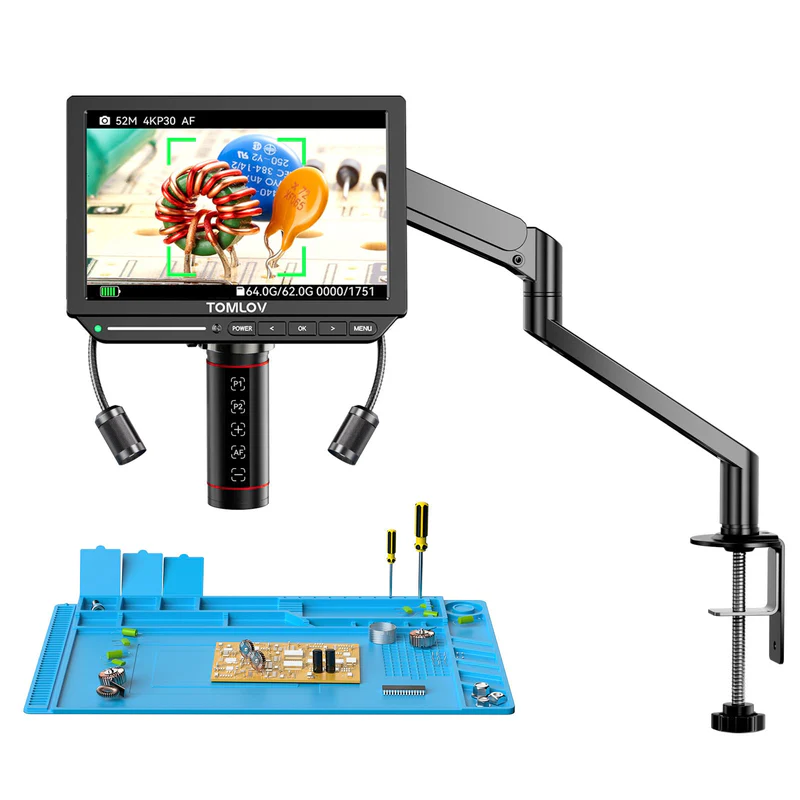
The key advantage of a 3D microscope lies in its ability to reveal the micro-scale architecture of objects with accuracy and clarity. Biological researchers can examine tissue structures, cellular morphology, and microorganisms from multiple angles, enhancing their understanding of function and pathology. In industrial applications, engineers use 3D microscopes to inspect circuit boards, mechanical components, and surface coatings for defects or inconsistencies. The combination of high-resolution optics and stereoscopic imaging provides an accurate representation of samples, facilitating informed decision-making and detailed analysis.
Moreover, digital integration with modern 3D microscopes allows for image capture, live streaming, and data documentation. This is particularly useful for research collaboration, teaching, and quality assurance, where detailed visual records are essential. By providing a complete and realistic view of specimens, a 3D microscope enhances both analytical capabilities and workflow efficiency.
Can Advanced Features Improve the 3D Microscope Experience?
Contemporary 3D microscopes are equipped with advanced features that elevate precision, usability, and observation quality. High-definition optics, adjustable magnification, and multi-angle viewing options allow for the detection of subtle surface features, microfractures, and intricate details that might otherwise go unnoticed. LED illumination and specialized lighting techniques improve contrast and reveal differences in texture, color, and material composition, making complex surfaces easier to analyze.
Digital 3D microscopes offer additional benefits, such as the ability to generate 3D models, take precise measurements, and conduct quantitative analysis. Researchers and industrial professionals can manipulate these digital models, rotate them, and examine cross-sections without physically altering the specimen. This non-invasive approach is particularly valuable when handling delicate biological samples or high-value industrial components. Ergonomic design ensures comfort during extended observation sessions, preventing fatigue while enabling long hours of precise examination.
In industrial inspection, the 3D microscope proves invaluable for identifying surface defects, verifying dimensional accuracy, and monitoring product quality. Its versatility makes it suitable for electronics, automotive parts, jewelry, and materials research, where surface integrity and structural details are critical. The combination of digital imaging, stereoscopic vision, and ergonomic usability ensures that the 3D microscope is a practical and efficient tool for professionals in diverse fields.
Can a 3D Microscope Enhance Research Accuracy and Productivity?
The ability to capture and analyze three-dimensional images fundamentally improves both the accuracy and productivity of research. In biological sciences, this capability allows detailed examination of tissue layers, cell clusters, and microstructures without invasive manipulation. Researchers can document precise morphological details, compare specimens, and share findings with peers, enhancing reproducibility and scientific rigor.
For industrial applications, a 3D microscope streamlines inspection processes by allowing rapid evaluation of components from multiple perspectives. Engineers can detect minute surface flaws, evaluate coating thickness, and ensure dimensional conformity efficiently. By reducing human error and providing reliable data, the 3D microscope supports faster decision-making and improves overall workflow efficiency. Additionally, the ability to archive high-resolution images and 3D models ensures that data is available for future reference, research validation, and training purposes.
The integration of software analysis with 3D microscopy also provides a powerful tool for measurement, surface profiling, and quantitative evaluation. This feature makes the device particularly useful in material science and industrial manufacturing, where precise measurements are critical for product reliability and quality assurance.
Conclusion: A 3D Microscope Redefines Observation and Analysis
A 3D Microscope is more than a visual enhancement tool; it is a transformative instrument that redefines observation, analysis, and quality assessment. By providing three-dimensional visualization, advanced lighting, and digital integration, it enables scientists, engineers, and researchers to explore samples with unprecedented clarity and precision. From improving scientific understanding and enabling detailed industrial inspection to enhancing teaching and collaborative research, the 3D microscope elevates both accuracy and productivity. Investing in a high-quality 3D microscope opens the door to deeper insights, reliable analysis, and innovative discoveries, making it an essential tool for modern laboratories and professional environments.

