

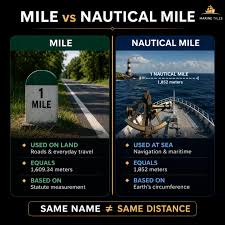
A standard mile, also called a statute mile, measures exactly 5,280 feet or approximately 1.609 kilometers. This measurement is mainly used for highways, driving distances, and land transportation in countries such as the United States and the United Kingdom.
A nautical mile is longer than a regular mile and equals approximately 6,076 feet or exactly 1.852 kilometers. Unlike the statute mile, the nautical mile is directly connected to the Earth’s latitude and longitude system. One nautical mile represents one minute of latitude on the Earth’s surface, making it extremely useful for navigation across oceans and international air routes.
This distinction becomes very important in maritime navigation and aviation because the Earth is curved. Standard land miles are practical for roads and terrestrial travel, but nautical miles provide greater accuracy when calculating long distances across seas and skies.
Modern GPS systems, aviation charts, marine maps, and international navigation technologies continue to rely on nautical miles because they align naturally with global coordinate systems.
Difference Between a Nautical Mile and a Mile in Maritime Navigation
The maritime industry depends heavily on nautical miles because ships travel across vast oceans where precise navigation is essential. Marine navigation systems use latitude and longitude coordinates, and nautical miles simplify calculations because they are directly tied to these coordinates.
Ship captains, sailors, cargo operators, and naval officers use nautical charts that display distances in nautical miles rather than standard miles. This allows them to determine routes, estimate travel times, and monitor vessel positions more accurately during long voyages.
The difference between a nautical mile and a mile becomes especially noticeable when calculating ocean travel distances. Since nautical miles are based on the Earth’s circumference, they help navigators avoid errors that could occur when using land-based measurements over curved sea routes.
Commercial shipping companies also use nautical miles to estimate fuel consumption and arrival schedules. International ports and maritime authorities communicate using nautical miles to maintain consistency between countries and shipping organizations worldwide.
Modern marine radar systems, satellite navigation tools, and GPS technologies all operate using nautical mile measurements. This universal standard improves safety and efficiency for vessels traveling through international waters.
The nautical mile has become an essential part of maritime operations because it provides a reliable and accurate method for long-distance sea navigation.
Difference Between a Nautical Mile and a Mile in Aviation Systems
The aviation industry also relies on nautical miles rather than regular miles for flight navigation and air traffic communication. Pilots use nautical miles to calculate flight paths, determine aircraft positions, and estimate travel times during domestic and international flights.
Aircraft speed is measured in knots, and one knot equals one nautical mile per hour. This relationship makes nautical miles highly practical for aviation calculations. Flight routes are based on geographic coordinates, which align naturally with nautical mile measurements.
The difference between a nautical mile and a mile becomes important in aviation because aircraft travel across large geographical areas and international airspaces. Nautical miles provide better accuracy for long-distance navigation and improve communication between airports and air traffic controllers.
Modern aircraft navigation systems automatically calculate distances using nautical miles. These systems help pilots optimize fuel efficiency, monitor flight progress, and improve operational safety during travel.
Air traffic control centers around the world also communicate using nautical miles to ensure consistent standards across international aviation networks. Since global air travel involves multiple countries and regions, a universal navigation system is necessary for reducing misunderstandings and maintaining flight safety.
Long-haul international flights especially depend on nautical mile calculations because they involve crossing oceans and remote airspaces where accurate positioning is essential.
Difference Between a Nautical Mile and a Mile in Historical Development
The historical origins of these two measurements explain why they developed differently. The regular mile evolved from ancient Roman road systems and was intended primarily for land transportation and travel distances.
The nautical mile, however, developed from the needs of sailors and navigators exploring the oceans centuries ago. Early mariners discovered that the Earth could be divided into degrees, minutes, and seconds of latitude. They observed that one minute of latitude closely matched a consistent distance on the Earth’s surface.
This observation led to the development of the nautical mile as a practical navigation measurement. Because oceans cover large curved surfaces, navigators needed a measurement system connected directly to Earth’s geography.
Different countries once used slightly different nautical mile standards, which caused confusion in maritime trade and navigation. In 1929, the international community officially standardized the nautical mile at exactly 1.852 kilometers.
This standardization improved communication and operational efficiency in shipping and aviation industries worldwide. Today, nautical miles remain the global standard for marine and air navigation, while standard miles continue serving road transportation and land measurement systems.
The advancement of modern GPS technology and satellite navigation has further strengthened the importance of nautical miles in global transportation networks.
Difference Between a Nautical Mile and a Mile in Modern Technology
Modern navigation technology continues to rely on nautical mile measurements because they integrate perfectly with Earth-based coordinate systems. GPS devices used in ships and aircraft automatically display distances in nautical miles for improved navigation accuracy.
Maritime transportation systems use nautical miles to monitor vessel routes, weather patterns, and operational performance. Aviation systems also depend on nautical mile calculations for flight management, air traffic communication, and route optimization.
Weather forecasting organizations use nautical miles when tracking hurricanes, storms, and safe travel zones across oceans and airspaces. Emergency rescue teams and military organizations also coordinate missions using nautical mile measurements.
Although regular miles remain common for road travel and everyday land transportation, nautical miles dominate industries involving global navigation. Their connection to geographic coordinates makes them far more suitable for long-distance travel across oceans and skies.
As international transportation continues evolving through advanced satellite technology and digital navigation systems, nautical miles remain one of the most dependable measurement standards used worldwide.
Conclusion
The difference between a nautical mile and a mile lies mainly in their purpose, measurement system, and practical application. A standard mile is ideal for land transportation and road travel, while a nautical mile is specifically designed for maritime and aviation navigation.
Because nautical miles are directly connected to the Earth’s latitude and longitude coordinates, they provide superior accuracy for long-distance travel across oceans and international air routes. Modern shipping companies, airlines, GPS systems, and navigation technologies continue relying on nautical miles to ensure safe and efficient transportation.

