

Can a 3D Microscope Improve Accuracy and Insight in Research?
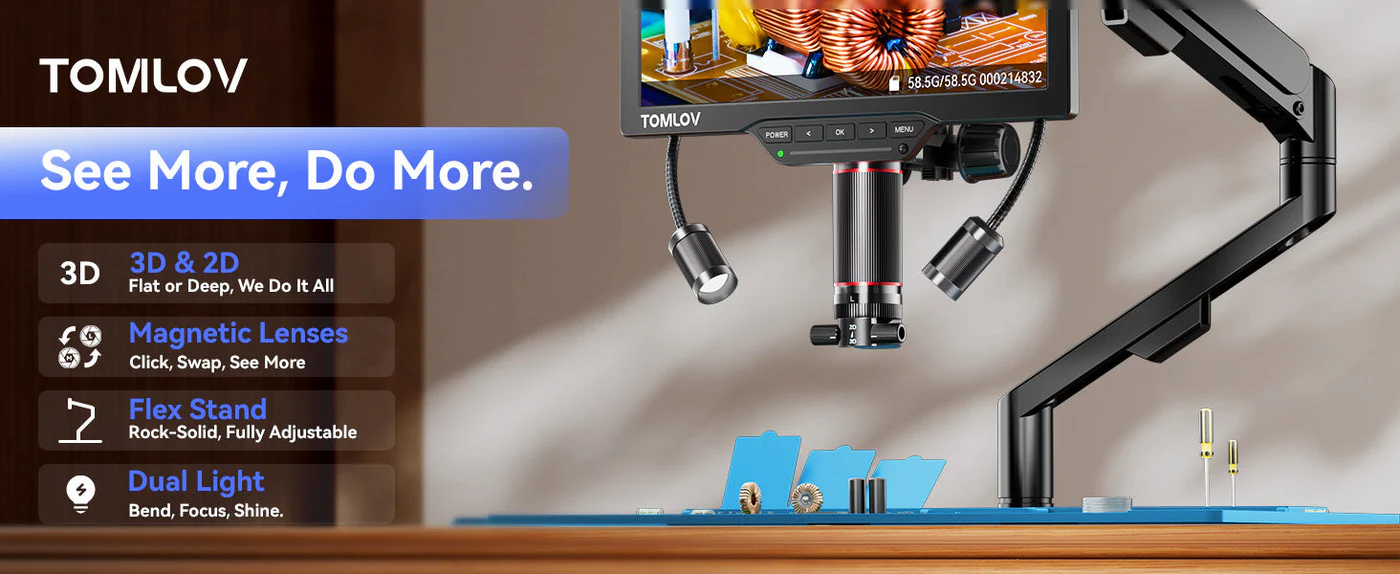
A 3D microscope provides far more than simple magnification—it delivers depth perception and spatial understanding that is essential for detailed scientific work. In biological studies, it enables researchers to examine tissues, cells, and microorganisms in three dimensions, revealing structural details that are often missed with traditional 2D observation. This multi-angle visualization allows for precise identification of abnormalities, improved understanding of cellular interactions, and a more comprehensive interpretation of experimental results.
In materials science and industrial inspection, 3D microscopes are invaluable for evaluating surface textures, microfractures, and defects in electronic components, metals, or polymer materials. Engineers and technicians can rotate and adjust the specimen without altering its position, capturing accurate measurements and reducing the likelihood of errors. This combination of precision optics and three-dimensional imaging supports confident decision-making, enhances research quality, and ensures that findings are reliable and replicable.
Can a 3D Microscope Enhance Digital Documentation and Collaboration?
Modern 3D microscopes often integrate digital imaging technology, allowing users to capture high-resolution photos and videos for documentation and collaboration. This functionality is essential for laboratories, educational institutions, and research facilities, where accurate records are required for analysis, comparison, and publication. Digital imaging reduces the need for repeated handling, protecting delicate samples while creating a permanent record of the specimen’s condition.
Advanced software features enable volumetric measurements, 3D reconstructions, and surface analysis, providing researchers with detailed insights that were previously difficult to achieve. In industrial applications, such as electronics or materials testing, this capability ensures precise inspection and quality control. Collaborative research also benefits, as images and models can be shared with colleagues worldwide, allowing for joint analysis, peer review, and verification without compromising the integrity of the specimens.
Can a 3D Microscope Support Education and Advanced Training?
Beyond professional research, a 3D microscope is an excellent educational tool. Students and trainees can observe specimens in three dimensions, which enhances understanding of complex structures, biological systems, and material compositions. For medical training, 3D visualization provides a clear perspective on tissue layers, cellular arrangements, and microanatomy. In engineering and industrial studies, learners can analyze components, surface textures, and assembly details more effectively than with traditional microscopes.
By offering interactive and hands-on experiences, 3D microscopes improve engagement and comprehension. Students gain a practical understanding of spatial relationships and structural details, fostering critical thinking and analytical skills. Educational institutions can incorporate live demonstrations, recorded sessions, and digital models to provide a more immersive learning experience. This approach prepares learners for real-world applications, bridging the gap between theoretical knowledge and practical expertise.
Can Investing in a 3D Microscope Provide Long-Term Professional Value?
Investing in a 3D microscope is a strategic choice for professionals seeking precision, versatility, and reliability. For researchers, it ensures accurate sample examination and credible results. In industrial and quality control applications, it supports defect detection, surface evaluation, and component inspection. Educational facilities benefit from enhanced teaching tools that enable students to explore specimens with clarity and confidence.
Long-term advantages include improved workflow efficiency, reduced observational errors, and enhanced documentation capabilities. Many modern 3D microscopes also feature automated scanning, cloud storage, and advanced analysis software, ensuring sustained value over time. By integrating high-quality optics with digital and three-dimensional imaging, 3D microscopes equip professionals and learners with the tools necessary to analyze, document, and understand complex structures with unmatched accuracy.
Conclusion
A 3D Microscope is a transformative tool that advances precision, clarity, and efficiency in scientific observation, industrial inspection, and education. By offering three-dimensional visualization, digital imaging, and advanced measurement capabilities, it enhances accuracy, documentation, and collaborative potential. From biological research to materials testing and advanced training, the 3D microscope allows professionals and students to examine specimens with unprecedented detail and depth. Investing in this technology ensures long-term value, enabling accurate, reliable, and insightful exploration of microscopic worlds.

